Scammed on Binance? Where to File a Report and What to Have Ready
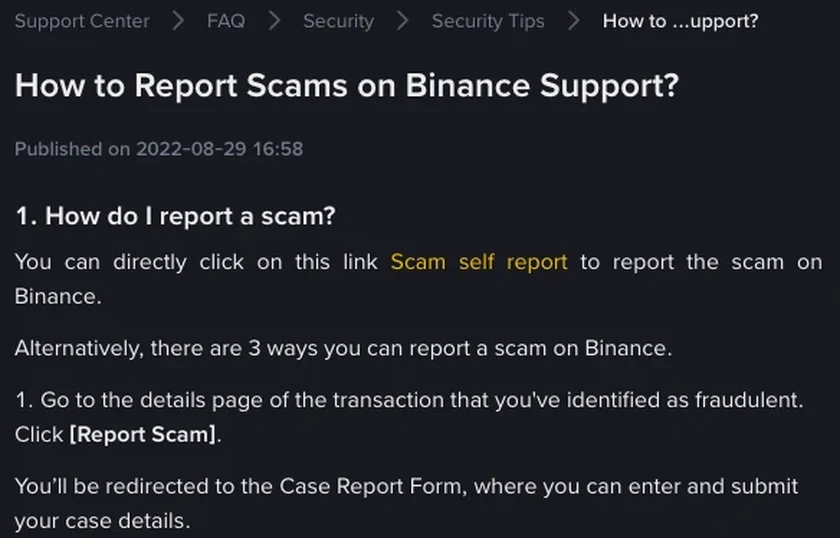
Money lost to a scam may not come back. Binance's Help Center article How to Report Scams on Binance Support? says fund recovery isn't guaranteed and that the best course of action is to report the incident to law enforcement, who may collaborate with experienced blockchain investigators to pursue the theft further.
The report to Binance should still be made. A Binance blog post dated 2022-10-20, Fraudulent Recovery Services: How Not to Fall for a Scam Twice, says actual recovery is dependent on police seizure orders and assistance from cryptocurrency exchanges, and the help article says Binance works closely with authorities to support their investigations and help prosecute those involved in fraud. So do both: submit the report form on Binance and file a report with your local police, using the same set of materials for each.
01Where to find the scam report form on Binance
The help article linked above, How to Report Scams on Binance Support?, is marked “Published on 2022-08-29.” It starts with a direct Scam self report link and then gives three ways to report on the platform. Use whichever is most convenient:
- The Scam self report link: it is at the top of that article and takes you straight to reporting the scam on Binance.
- [Report Scam] on the transaction's details page: go to the details page of the transaction you've identified as fraudulent and click [Report Scam]. You're redirected to the Case Report Form, where you enter your case details and submit. The sample image in the article is the details window of a withdrawal.
- [Non-P2P Related Scam Report] in Binance Support: log in to your verified Binance account on the official Binance website and click the [Binance Support] icon at the bottom right of the screen. In the Self Service section, click [View All], then scroll down to [Non-P2P Related Scam Report]. You're redirected to the Case Report Form.
- Telling Binance Support what happened: log in the same way, click the [Binance Support] icon and explain your situation clearly. The article's examples of what you might type are “I want to file a scam report” and “I was cheated.” Click the case report link in the Customer Service response to reach the Case Report Form, then enter your case details and submit.
Note the label on the third option, [Non-P2P Related Scam Report]: as worded, it is for scams unrelated to P2P trading. If a P2P order goes wrong, file an appeal on the order page; if the seller doesn't respond, customer service handles it under Binance's P2P appeal handling rules.
The Help Center article, read in October 2026, says the Case Report Form is currently only available to Binance users. To report through the link in a Customer Service response, you log in to your verified Binance account first; if you haven't logged in, you can report cases through Binance Support directly. The form also currently only supports reporting withdrawal and payment scams, and for other scams, NFT scams for example, the instruction is to contact Binance Support. That is the page's wording; go by what the form itself shows when you open it.
Click the [Binance Support] icon only on the Binance website you reached by typing the address yourself. Don't click support links sent to you in direct messages, group chats or search ads. Our guide to contacting official exchange support and what to prepare explains how to find the genuine support channel.
02Which report type to choose on the scam report form
The form asks you to choose a [Report Type]. The help article describes each one, so look for the description closest to your case. The names in the right-hand column are the labels as the English help article gives them.
| What happened to you | Closest report type |
|---|---|
| A fake shopping site or an individual sold physical or digital goods far below market price, or invited you to a giveaway or airdrop; you paid from your Binance account and the goods, rewards or services (loss recovery, for example) never arrived | [Payment without Delivery] |
| Someone you met on social media, a dating app or a messaging app arranged a crypto trade through a third-party app and disappeared after receiving your crypto | [Off-Platform Crypto Exchange] |
| Someone threatens to leak sensitive, embarrassing or private information (explicit videos, for example) unless you pay or meet their demands | [Blackmail or Extortion] |
| Someone says they can offer you a job and asks you to deposit money before you start | [Job or Income Scam] |
| You were led to invest in a so-called high-yield platform; someone on a dating platform offered to help you invest; someone on a website or app posed as a crypto expert, investor or broker and used high returns as bait | [Fake Investment] |
| You transferred assets from your Binance account to someone posing as a Binance employee; or someone posing as a bank, the police, a tax office, customs, a government agency, a well-known wallet or exchange, a study-abroad agency, or even a friend of yours, tricked you into a transfer and vanished | [Impersonation Scams] |
| You were tricked into installing remote-access software such as AnyDesk, and the other party got into your crypto account and made unauthorized transactions | [Remote Access Scams] |
| Someone abandoned a project and disappeared with the funds you had invested | [Rug Pull] |
| You were scammed by a relative, a real-life friend or someone a friend introduced | [Known Acquaintance Fraud] |
| In a face-to-face deal, the other party agreed to complete a crypto trade and disappeared after receiving your transfer | [Face2Face Fraud] |
| You were led to buy a worthless fake token | [Fake Token Fraud] |
| The physical or digital goods you received (an account or software, for example) do not match the seller's description | [Item Not as Described] |
| Your situation matches none of the above | [Others] |
A separate set of situations is also listed as reportable with the form. Beyond those described in the table, they include a live-streaming platform that claims to partner with Binance, asks you to send money to an unknown account to claim a giveaway and disappears once paid; a platform that says it will help you profit from trading and, after you deposit, refuses withdrawals unless you pay a very high fee; and the typical Ponzi scheme, which has you invest and bring friends to deposit on a fake third-party platform, where the deposited money vanishes.
03What to prepare before you file a scam report with Binance
The report form asks for the details of the case. The item-by-item list of what to hand over appears in the Help Center's answer about errors when submitting the form: if the form fails, contact Binance Support and submit the details of the scam manually, with the following attached.
- Details of the fraudulent transaction: transaction ID, date, amount, and the scammer's wallet address and Binance ID
- A short description of how the suspect contacted you and what method they used
- Links to the fraudulent website and social media, if any
- The username of the other party's account, if they approached you through social media
- The suspect's crypto address, if any
- If you received a phishing email, that email exported as an .eml file
- Screenshots of your chat history with the suspect
- If the form did return an error, a screenshot of the error screen as well
The list was written for manual submission after an error, and it works equally well as a checklist to prepare in advance. With everything except the error screenshot gathered before the form is opened, the case details can be filled in from it, and an error on the form will not send you back through your records.
The transaction ID comes from your own transaction or withdrawal history: pick the transfer that went to the scammer's address and use its ID. If that transfer does not show in the list, adjust the time range and look again.
Everything on this list concerns the transaction and the other party. Your own login password, verification codes and seed phrase are nowhere on it. Anyone who asks for those while claiming to help process your report should not be given them.
The same materials serve for the police report. The Binance blog post has a section on reporting to law enforcement: provide as much information as possible, including any communications, contact details, social media profiles, and the relevant cryptocurrency addresses and transactions. The process differs around the world, and in many countries it may be more efficient to report in person, especially for more serious incidents or large losses.
04Will Binance tell you the outcome after you submit a scam report?
It will try to keep you informed, though details may be withheld. The help article says Binance will do its best to keep you informed but may be restricted by law or compliance from disclosing explicit details about ongoing investigations to users, which is why it encourages you to report any scam to law enforcement. On recovery, the answer is that blockchain transactions are irreversible and anonymous, so that despite Binance's best efforts “it may be unlikely that we, as an exchange, can recover the scammed funds.”
The article gives no handling time and no place to check progress. While waiting, get the police report filed. For law enforcement agencies that require its assistance, the blog post says, Binance maintains a dedicated request form on its portal.
05Is it worth paying someone to recover crypto lost to a scam?
Binance's advice is not to. The blog post linked at the top of this guide, written by members of Binance's Global Intelligence and Investigations team, is about exactly these services. Some are scams outright: they pose as a legitimate way to recover funds lost to theft, fraud or hacking, which means they target people who have already lost money to criminals. The post calls this another form of advance-fee fraud, in which victims pay upfront expecting larger returns later. Others are private blockchain investigators who do produce a tracing report, but that tracing “tends to be of rather poor quality, created by automated tools without human review, and is often so ambitious that it is detached from reality.”
How these services operate, in the post's telling:
- They mostly require a flat fee upfront regardless of the outcome of their tracing or fund recovery, and often want a fee before engaging with a victim's case at all. The post cites the US Federal Trade Commission (FTC) as warning that these upfront fees can be called many different things, including a “retainer fee,” “processing fee,” or “administrative charge.” An FTC consumer alert from November 2022, Worried about crypto exchange losses? Don't pay money for “help” recovering money, tells readers not to pay anyone who contacts them offering to recover money lost to a scam.
- They promote themselves in places where victims are looking for help, a warning the post attributes to the US Commodity Futures Trading Commission (CFTC). Its authors add that they have encountered suspects advertising on social networks, forums and consumer review websites focused on investment losses.
- Fraudulent recovery services are often owned by individuals connected to investment fraud networks, and government agencies have issued warnings that such services commonly recycle victim lists from the initial scams.
Despite the claims they make to their clients, the post continues, private companies “can never recover stolen funds on their own.” They try to rely on information-sharing from exchanges, which they often cannot secure, because legitimate services in the industry are bound by privacy regulations and by obligations to users not to share customer data with unauthorized third parties. Binance's stated position is that it does not process requests from private investigators without involvement from law enforcement or a legitimate legal request. The advice that follows is to report the crime to law enforcement instead of engaging a third-party recovery service, because what you would most likely be paying for is “a report of indeterminate quality, not the actual recovery of your funds.”
If you already paid a recovery service from your Binance account and it delivered nothing, that can be reported too: the help article's description of [Payment without Delivery] gives loss recovery as an example of a service that was paid for and never delivered. Don't hand over your bank account information afterwards either; the blog post says victims should avoid sharing sensitive details like that with alleged recovery services.
FAQPassing a scam tip to Binance
How do I submit a scam tip to Binance?
Binance's help article says to use the same Case Report Form. Select [No] on the pop-up “Have You Lost Money?” and you are redirected to the Scam Report page. Under “Report type” select [Others], and under “Others” enter “Providing scam leads.” Fill in the relevant fields with what you know about the scam, check the terms of use box and click [Submit].