How to Turn USDT Back into Cash: The Full Bank-Card Cash-Out Flow
You've built up some USDT and want to turn it back into spendable cash in your bank account, but you hunt around Binance and can't find a "cash out to bank card" button, where a lot of beginners get stuck on their first cash-out. The reason is simple: this isn't a one-tap "withdrawal," it's selling your USDT first, converting it to cash, and having the buyer send it to your account. This guide explains that whole path clearly, and along the way covers the frozen-card worry everyone has.
01Why there's no "one-tap to a bank card"
Binance is a crypto exchange; what sits in your account is coins, not cash. To turn coins back into cash, someone has to be willing to buy your coins with cash. That "matching of buyers and sellers" market is C2C (also called P2P, peer-to-peer trading).
So the essence of cashing out is: you sell your USDT to a real buyer on C2C, and the buyer sends you the cash via a local payment app (e.g. bank transfer). The platform holds escrow and guarantees in the middle, after you place the order your USDT is frozen, and only when you confirm you've received the money is it released to the buyer, protecting both sides. USDT itself is a stablecoin pegged to the US dollar; for its issuance mechanism see the Tether site, and for the concept of a stablecoin you can read Investopedia's stablecoin entry.
Once you grasp this, you understand why there's no "one-tap to a bank card" button: the money doesn't come from the platform directly, it comes from another user. This path is a different thing from withdrawing crypto (moving coins to an on-chain address); if you want to get the difference between the two straight, first read the comparison in the complete withdrawal guide.
02Cashing out by selling USDT on C2C: step by step
The flow below is one a beginner can just follow. The exact wording differs a little by version, but the logic is the same.
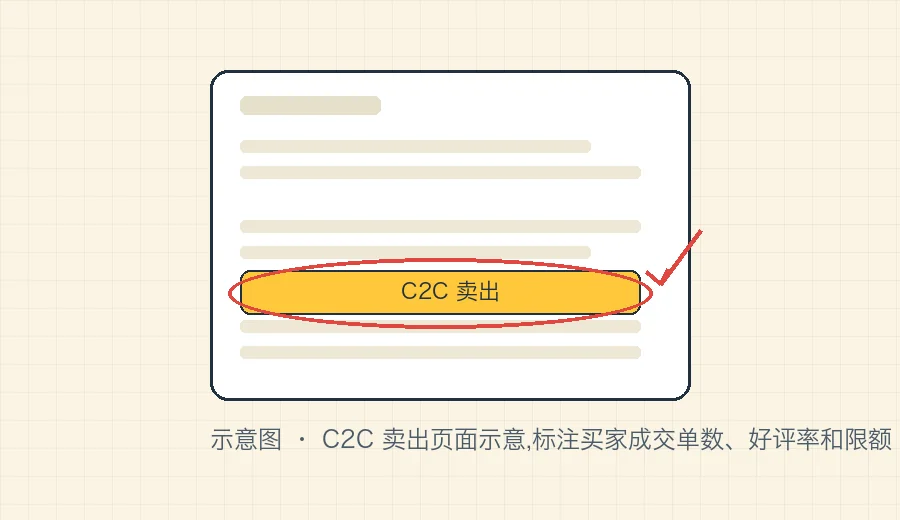
- Open the C2C "Sell" page. Choose the coin USDT, choose "Sell." The system lists a stack of buyer ads.
- Pick a buyer. Focus on three things: completed-order count (the more the more reliable), positive rating (the higher the better), and per-trade limit (whether it covers the amount you're selling this time). Then check whether the payment methods they support are convenient for you (bank transfer / local payment app). As a beginner, prefer buyers with thousands of trades and a very high rating.
- Enter the amount, place the order. Fill in the USDT amount you want to sell, or the corresponding cash amount, and confirm. Your USDT is now frozen into escrow.
- Provide payment details, wait for the buyer to pay. Give your receiving account per the chosen method. The buyer pays within the allotted time.
- Verify arrival, then release. This is the crucial step: open your own bank app or payment app, confirm the money has genuinely arrived and the amount matches, then go back to the order and tap "Confirm release."
- Release complete. The frozen USDT goes to the buyer, this cash-out is done, and the money is in your account.
The scammer's most common move is to send a fake "payment successful" screenshot to rush you into releasing, or to claim "I've already paid, the bank is delayed, release first." Remember: trust only the real arrival in your own bank app, ignore screenshots entirely, and never release before the money is in. Hold this one line and you'll block the vast majority of cash-out scams.
For a finer breakdown of picking buyers, spotting tainted USDT, and various social-engineering scams, I've written it up separately in is C2C safe, and how to avoid tainted USDT and frozen cards, which I strongly recommend reading alongside your first cash-out. Conversely, if you want to buy USDT with cash, the flow is in how to buy USDT with your local currency.
03Frozen-card risk: prevent it, don't wait for trouble
This is the part of cashing out you should take most seriously, since it touches your real money and your bank account, so I'll speak plainly.
A "frozen card" means your bank account gets frozen and can't be used normally. In a cash-out scenario, the leading cause is: the buyer paying you has a problem with the money itself, for example funds from fraud or online gambling. When the matter is investigated and the bank traces the money trail, an account that received it (that is, yours) may be flagged by risk controls and temporarily frozen pending review. This isn't directly tied to whether you knew, so the focus is on lowering the odds in advance:
- Only pick well-reputed buyers. Buyers with many completed trades and a high rating have been at this a while and draw few complaints, so their money is relatively clean. Don't chase an unknown buyer with a handful of trades just for a sliver of better price.
- Avoid large, frequent receipts in a short window. Big amounts and dense counts trip bank risk controls on their own. As a beginner cashing out, prefer splitting it up, keeping amounts small, and spacing them out.
- Keep your trade records. Save order records, chat logs, and arrival screenshots. If risk controls come knocking, you can show this was a normal C2C trade, which helps it get unfrozen sooner.
- Use a regular account in your own name; don't use a dormant or brand-new card just to receive. Unusual accounts get flagged more easily.
If a card freeze does happen, don't panic and don't hide. Usually you'll first get a notice from the bank or the relevant authorities, and you'll need to cooperate by explaining the source of the funds and providing trade records. Bring out the orders and arrival records you saved and explain honestly that it's proceeds from selling crypto on C2C. Most temporary freezes on normal trades get resolved after you cooperate with the review. The exact process follows the requirements of the bank and the handling authority, this is a matter for legal and financial institutions, and this site can only remind you to keep evidence and cooperate; it can't replace professional advice.
Get clear on the risks before cashing out. Run through the scam self-check tool, or read how to avoid tainted USDT and frozen cards, that matters more than rushing to sell. See the C2C safety guide →
04Compliance and paper trail, a few honest words
The laws, regulations, and supervisory stance on crypto and cashing out differ by place, and they're changing. I won't make the call for you here, just a few universal, practical pointers:
- Know the rules where you live. Different countries and regions treat holding, trading, and cashing out very differently. Before you act, find out the rules in your own location; don't assume.
- Keep money traceable in and out. Keeping a complete record of your buys and sells, with a clear money trail, is the best way to protect yourself.
- Steer clear of obviously abnormal high-priced offers. Some people offer to buy USDT well above market, and that kind of "good deal" is often dirty money looking for an exit, with huge risk attached. A price gap that's abnormally large is itself the alarm.
- Act within your means, spread it out. A beginner needn't dump a large sum out at once; split it into a few rounds, keep your receipts, and play it steady.
With cashing out, slow is fast. Pick your buyer well, verify arrival carefully, and keep complete records, and the vast majority of people get their money back to the card smoothly. If you have questions at the rules level, prioritize the current pages of the official Binance Help Center, along with the public guidance from the financial regulator where you live.
FAQFAQ
Is there a fee to cash USDT out to a bank card?
At the step of selling your USDT to a buyer on C2C, the platform usually doesn't charge ordinary users a separate matching fee; your cost mainly shows up in the trade price (the gap between your sell price and the market price). Whether any fee applies, and on what basis, follows what the Binance C2C page shows right now. The step where the buyer sends cash to your bank is a matter for the bank / payment channel and usually carries no extra fee.
Why do some people have their bank card frozen after cashing out?
The main risk is receiving funds of dubious origin. If the buyer paying you has money tied to illegal activity such as fraud or gambling, a bank's risk-control system may freeze the receiving account while tracing the money. This isn't directly related to whether you knew, so when cashing out, prefer well-reputed buyers, keep your trade records, and avoid large, frequent receipts in a short window.
When selling USDT, the other side says release first then they'll pay. Can I trust that?
Absolutely not. The normal C2C flow is: the buyer pays first, you confirm the money has genuinely landed in your bank account, then you release. Anyone telling you to release first, or sending a payment screenshot to rush you into releasing, is running a scam. Trust only the real arrival record you see in your own bank app, and never tap confirm before the money is in.