Is P2P Buying Safe? How to Avoid Tainted Funds and a Frozen Account
"I just bought a bit of USDT — how did my bank account suddenly get frozen?" — this is the scenario in P2P that gives people the most pause. Frankly, P2P has its conveniences, and escrow solves the "coins not arriving" problem; but it carries a risk beginners often don't realize: if the person you trade with uses funds linked to a case, then as the money trail is traced, you can be caught up in it. This piece doesn't scare you and doesn't teach you to game the system — it just lays out where the risk comes from, how to minimize your own exposure, and how to protect yourself compliantly if something goes wrong.
01What tainted funds are, and how a freeze actually happens
First, two terms made clear.
Tainted funds (sometimes called "dirty" USDT) is an informal term for the portion of USDT — or money associated with it — whose origin is tied to fraud, gambling, money laundering and other illicit activity. Note: the problem isn't the USDT token itself — USDT is neutral, anyone can hold it; the problem is where the money came from.
A frozen account means your bank account is temporarily frozen. The most common chain is this: someone uses money obtained through fraud or gambling to buy/sell USDT on P2P, this case-related money passes through several hands, and you happen to be one link in the chain (say, the local currency you received came down this path). When authorities trace the flow of funds step by step and freeze along the way, your account, as one stop on the chain, can be frozen along with the rest and asked to explain where the money came from.
A freeze does not mean you're found to have broken the law. Most ordinary users are passively caught up, and once it's checked out and the source is explained, the account is unfrozen. But that process can take time and disrupt normal use of your account — so the focus is on lowering the chance beforehand and keeping records that let you clear yourself.
02Lowering the risk: a few things you can do
No method drives the risk to zero, but the following genuinely push the odds down:
- Only use the platform's escrowed trades, don't add someone privately to "trade off-platform and save on fees." Leaving the platform means losing escrow and records — risk spikes.
- Pick reputable merchants, looking at completed-order count, completion rate (say 95%+), and a platform-verified badge. Favor large merchants with a long, stable track record.
- Use an account in your own name, whatever the payment method — it must be verified to you, sent to the receiving party shown on the page, with the amount matching. Never help anyone receive or pay on their behalf, and never use someone else's account.
- Don't make amounts too large or too frequent, as large, high-frequency dealings with many unfamiliar accounts are themselves more likely to draw risk controls and scrutiny. Buy as you need; don't turn your account into a channel for constant in-and-out.
- Add no sensitive note to transfers, just treat it as an ordinary transfer and note nothing.
Anyone egging you on with "trading privately off-platform is a better deal," "pass a payment through for me and there's something in it for you," or "let me use your card to receive and I'll move it right out" — however smooth it sounds, refuse, every time. These are often the entry point that drags you into a tainted money trail. Saving that bit on fees comes nowhere near covering a frozen card and the trouble that follows.
If you're unsure whether a request to "help with a transfer" is a scam, run it against common scripts with our scam self-check tool first, and decide with a clearer head. Binance has also compiled P2P anti-fraud reminders — check the current pages of the Binance help center.
03Keep good records: your proof for self-protection
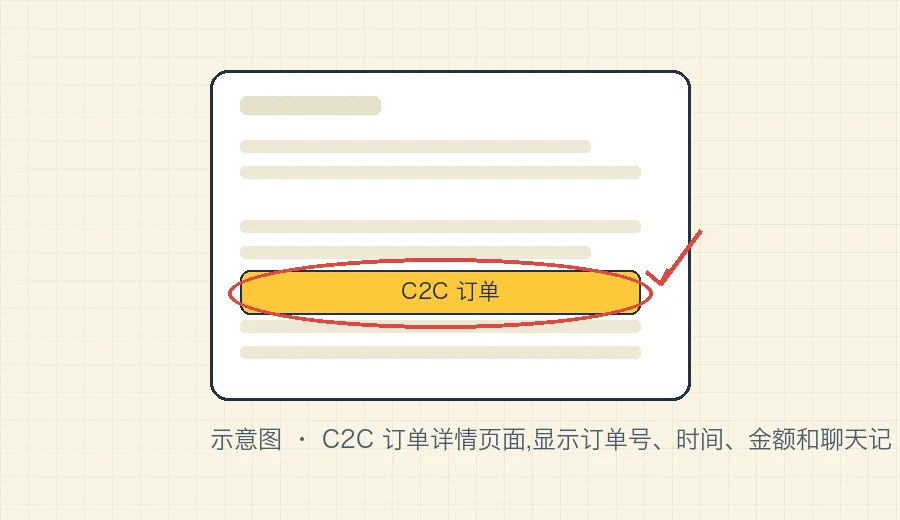
If a review ever comes, whether you can quickly explain "this money was a normal crypto buy, the source is clean" depends entirely on whether you kept records. I'd suggest saving these for every P2P trade:
- The platform's order records (order number, time, amount, counterparty info) — the platform can usually export these.
- Your payment/receipt proof (bank statement, transfer screenshots from a payment app).
- The chat logs from the order (especially the conversation confirming the receiving party and amount with the merchant).
- Material that shows the "clean origin" of the money — for instance, that the money you used to buy came from your salary or savings in your own account.
You won't use these day to day, but when you do need them, having them versus not is night and day. Make it a habit: snap a screenshot after buying, export your orders every so often — it takes only minutes. My own approach is to keep a dedicated album or folder just for these, ordered by date, so when needed it's all there at a glance rather than a frantic last-minute hunt.
04If reviewed or frozen, how to cooperate
If it does happen to you one day, remember a few principles:
- Don't panic, don't act rashly. Don't rush to shuffle money between your other accounts — that only complicates things.
- First find out who and why. Which body froze it, over what matter — the bank or investigating party will have the relevant information; understand the picture before acting.
- Gather proof, cooperate in explaining. Have the orders, statements and chat logs mentioned above ready, and truthfully explain your source of funds and how the trade went, as required. Cooperating openly with the review is the proper path for an ordinary user to clear themselves.
- Consult a qualified lawyer when needed. For specifics involving a case, a larger amount, or a long-running matter, consult a practicing lawyer and handle it through proper legal procedure.
What this site teaches is always the direction of "cooperate with reviews, protect yourself compliantly" — never any way to evade oversight or to move or hide funds. That's not only useless; it can turn you from "passively caught up" into "actively breaking the law." For legal issues, follow the requirements of the relevant authority and the advice of a qualified lawyer.
For more on fund safety and common beginner traps, read on with the 8 traps beginners fall into most. To understand what to watch on the other end — withdrawing USDT back to a bank — see how to cash out USDT to a bank. For general background on anti-money-laundering and compliance, you can also refer to Investopedia's explainer on anti-money-laundering (AML), and what KYC (Know Your Customer) is.
FAQFrequently asked questions
What are tainted funds (or "dirty" USDT)?
It's an informal term for USDT — or money associated with it — whose origin is tied to fraud, gambling, money laundering and other illicit activity. The problem isn't the USDT token itself but the money trail: if your counterparty uses funds linked to a case to trade with you, then when a bank or investigator traces the trail, your account can be caught up, frozen and asked to cooperate with an inquiry.
Why would my bank account get frozen just for buying crypto?
Usually because your counterparty's funds were caught up in some matter under investigation. As authorities trace the flow of funds step by step, you — as one link that received or sent money — can be temporarily frozen and asked to explain where your money came from. This doesn't mean you're found to have broken the law, but you do need to cooperate and provide transaction records to clear yourself.
My account got frozen — what do I do?
Stay calm and don't move funds around in a panic. First find out which body froze it and why (the bank or the investigating party will have information), gather your transaction proof, chat logs and platform order screenshots, and cooperate in explaining the situation as required. This is a legal-procedure matter; for specifics involving a case, consult a qualified lawyer. This site is not legal advice.