Is Binance Safe? Will It Collapse? What Beginners Worry About Most
"If I put money in, will it one day collapse and leave me with nothing?" If you're stuck hesitating at the sign-up step, this thought has probably circled your mind a few times. It's normal to think this way, even a good sign, it means you haven't been blinded by "get rich quick" and still remember to ask about safety first. In this piece I won't shill for any platform, nor scare you; I'll lay out plainly what security measures Binance has taken, what the industry has been through, and the part that's within your control. By the end you'll see that a big part of what really determines whether your assets are safe is, in fact, in your own hands.
01What security measures Binance has taken
Start at the platform level. As a top exchange that has long ranked high, Binance's publicly promoted security mechanisms are mainly these few; get a sense of them so you have your bearings.
Cold storage. Exchanges typically keep most user assets in offline cold wallets, leaving only a small portion in hot wallets to handle daily withdrawals. Cold wallets aren't online, so they're hard for hackers to reach remotely, a standard industry practice aimed at lowering the risk of getting wiped out all at once.
The SAFU user protection fund. Binance set up an emergency fund called SAFU (Secure Asset Fund for Users) as a buffer to protect users in extreme situations. Its existence means that in certain security events, there's a reserve that may be used to make up user losses. The exact coverage and payout rules follow the official explanation, don't read it as "fully reimbursed for anything."
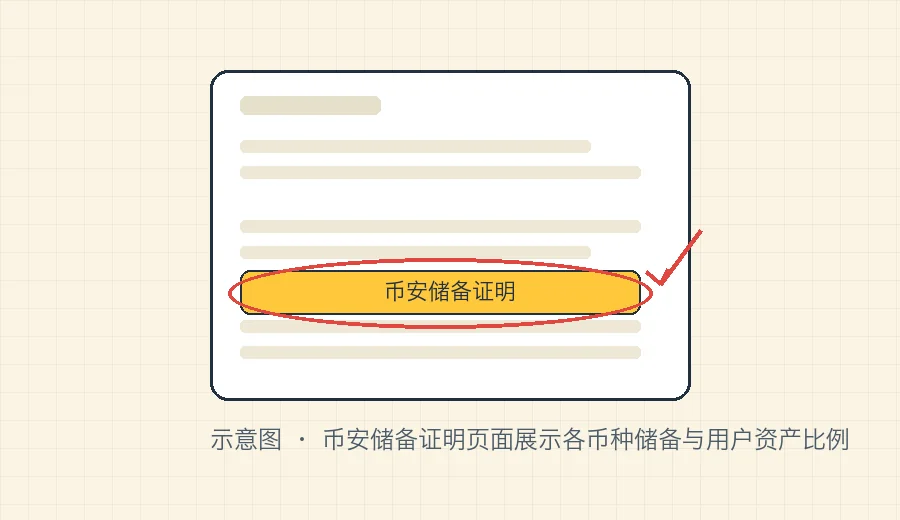
Proof of Reserves. After the FTX blowup, top exchanges rolled out proof of reserves one after another, publicly showing whether the assets they hold can cover user deposits. Binance also provides a proof-of-reserves page, letting users verify to some extent whether the platform's assets are sufficient. This is progress on transparency, but it's a snapshot at a point in time and has methodological limits, so don't treat it as foolproof insurance.
Account-level security features. Beyond these platform-level measures, Binance gives every user a full set of account security tools: two-factor authentication (2FA), an anti-phishing code, a withdrawal address whitelist, device management, and more. This part is especially important, because for an individual user, the truly high-frequency risk isn't the platform being hacked, it's your own account being compromised, password leaked, phished, or phone infected. Turn these features on and you block the vast majority of attacks aimed at individuals. In other words, the platform builds the city wall for you, but the door lock is yours to lock.
Stacked together, these mechanisms do make a top platform far steadier than some shady small exchange. But remember one line: these all "lower the risk," and not a single one turns the risk to zero. The next section is about why that "zero" doesn't exist.
02"Will it collapse," objectively
To be honest: no one and no institution can guarantee that a given centralized exchange "will absolutely never run into trouble." This isn't talking down Binance, it's the objective reality of the industry, and you have to accept this premise before you can talk rationally.
Looking back over the years, examples of exchange blowups aren't rare. In the early days, Mt. Gox was hacked and a huge amount of Bitcoin disappeared; in 2022 FTX went from industry giant to sudden collapse, with countless users' money stuck inside and unwithdrawable. These lessons say one thing over and over: keeping coins on any centralized platform is, in essence, entrusting your assets to a company, and what you trust is that company's operations, risk control, and integrity. However big a company is, it doesn't mean zero risk.
So why do many people still choose a top platform? Because given the premise of "you must pick a centralized exchange," a top platform with strong liquidity, heavier compliance investment, relatively higher transparency, and survival through multiple market cycles has relatively lower odds of trouble, a relative, not absolute, safety. The rational attitude is: don't bet any platform is definitely safe, but spread your eggs and keep the part you can control firmly in your own hands. Which leads to the most important principle below.
Be wary of any claim of "100% safe," "principal-protected," or "absolutely never goes wrong," whether about a platform or some yield product. In crypto, anyone who keeps the word "absolutely" on their lips is either clueless or out to scam you. In the real world there's only probability and risk management, no absolute safety.
03The one to remember: don't keep all your assets on an exchange
If you remember only one sentence from this piece, remember this: don't keep all your crypto assets long-term on any one exchange.
Crypto has an old saying, "Not your keys, not your coins" (if the private keys aren't in your hands, the coins aren't truly yours). Coins on an exchange are, strictly speaking, a bookkeeping entry the platform holds for you, with the real private keys in the platform's hands. While the platform runs normally this is fine, but once it runs into trouble, gets frozen, or hits regulatory issues, your withdrawals can be affected.
A reasonable allocation approach: keep the part you trade often and will move short-term on the exchange for convenience; move the part you plan to hold long-term and rarely touch into a wallet whose private keys you control. That way, even if some platform has an incident, what's affected is only the small part you left there, not your entire net worth.
Of course, managing your own wallet has its own management risk, a lost seed phrase can't be recovered by anyone, and being phished is also a one-way trip. So it's not that "a wallet is definitely safer than an exchange," it's that the two risks are different in nature and should be spread apart. For how to weigh the two custody approaches, see what's the difference between a wallet and an exchange, and which one a beginner should use first, cold wallet vs hot wallet, which one should a beginner use.
Managing your own wallet comes down to safeguarding the seed phrase. The seed phrase equals the final password to this money; anyone who gets it can move the coins away, and once moved it can't be recovered. Never screenshot the seed phrase, save it in your phone's photo album, send it in a chat box, or upload it to a cloud drive, and certainly never tell anyone, including anyone calling themselves "support" or "technical assistance." This has no exceptions. See what are a seed phrase and a private key, and what happens if you lose them.
04A more real threat than a platform collapse: fake Binance, fake support
Here's something that may run counter to intuition: for the vast majority of beginners, what really makes you lose money is often not a top platform collapsing, but that you never used the real platform at all, you got scammed by a fake site, a fake app, or fake support. This happens every day, far more common than a platform blowup.
Common playbooks: a spoofed official site with a domain a letter or two off from the real one, where you enter your username and password and get fished; a fake app downloaded from a non-official channel that looks identical to the real one, where the coins you store go straight into a scammer's pocket; fake support that impersonates the official on social platforms or in search ads, messages you proactively, and on the pretext of "account abnormality" or "helping you unfreeze," tricks you into transferring money or reading out a verification code or seed phrase.
What these scams share is exploiting your trust in "the official" and your panic when something goes wrong. Remember one iron rule, the official will never message you proactively asking for money, a verification code, a seed phrase, or to move coins to some "safe address." Anyone who does is 100% a scammer, no exceptions. For how to tell real from fake entries one by one, the site has a dedicated piece, how to spot fake exchange apps and phishing sites, strongly recommended before you sign up.
There's another, more hidden, pit: fake platforms and fake projects flying the "high yield" flag. They may impersonate a big platform's name, or be an entirely new scheme; what they share is promising you "stable high returns" or "referral rewards for recruiting others." This is a different matter from whether a platform is safe, your money never entered a real platform, it went straight into a scammer's pocket. The yardstick is plain: anything promising a fixed high return, rushing you to deposit, or earning by recruiting downlines, however professionally packaged, should be treated as a scam. Holding this line is more useful than studying any platform's security mechanisms.
To understand the general workings of phishing and social-engineering attacks, you can refer to Investopedia's explanation of phishing scams; for the security essentials of self-custody wallets, ethereum.org's security guide is fairly systematic too.
05A few survival tips for beginners
To wrap up, a few you can act on directly:
1. Stick to official channels only. Download the app from the official app store or site, bookmark the official site and always enter from the bookmark, and don't click search ads or unfamiliar links.
2. Do your security setup right after opening the account. Bind 2FA (two-factor authentication), set an anti-phishing code, and set up a withdrawal address whitelist, these block more than half of account theft and phishing. For the steps, see the security setup to do after opening an account.
3. Spread your assets, don't pile it all in one place. Keep the everyday part on the exchange, move the long-term part to your own wallet, and store the seed phrase offline.
4. Think through how much to put in. Use spare money you can afford to lose, don't go leveraged, and don't touch futures you don't understand. What a beginner most needs to learn isn't "how to earn," it's the 8 pitfalls beginners hit most and why beginners are told to avoid futures.
Do these few and your security level is already far ahead of most people just entering the market. You can't control much of the platform's safety, but everything above is entirely in your own hands. When you're ready, follow the Binance sign-up guide step by step; Binance's official security features and proof of reserves follow the current pages of the official Binance Help Center.
Referral code BNB8816
FAQFAQ
Could Binance collapse the way FTX did?
No one can guarantee any centralized exchange will absolutely never run into trouble, that's a fact and a premise you have to accept. But a few things can be viewed objectively: Binance is currently a top platform that has long ranked high in trading volume, it has published a Proof of Reserves, it maintains a user protection fund (SAFU), and most assets are kept in cold storage. These mechanisms lower the risk, but they don't make it zero. The rational approach isn't to bet a platform is definitely safe, it's to not put your whole net worth on any single platform.
Which is safer, keeping coins on Binance or in my own wallet?
The risks are different. On an exchange you face platform risk (theft, blowup, being frozen); in your own wallet you face self-custody risk (a lost seed phrase, getting phished, sending to the wrong address), and no one can recover it for you. For a complete beginner, keeping a small amount on a large platform at first and spending your energy on learning to operate and avoid scams is often steadier than rashly managing your own private keys; once your holdings grow and you've understood it, move the long-term untouched portion to your own wallet.
How do I confirm I'm using the real Binance, not a fake site or app?
Download the app only from official channels, log in only on the official domain, bookmark the official site and always enter from the bookmark, and don't click search ads or unfamiliar links. Anyone claiming to be support who messages you, has you transfer money or read out a verification code, is a scammer, the official won't do this. Turning on 2FA and an anti-phishing code further helps you recognize fake emails. For how to tell real from fake entries one by one, see the spotting-fake-apps piece on this site.